Create QR CodesCreate QR CodesSign in

QR code for business cards · 11 min read · Updated 2026-08-31

How to Add a QR Code to a Business Card

Create a scannable QR code for business cards: print 2.5–3 cm, skip the 12 mm corner, and use a dynamic link so a job or site change does not kill the card.

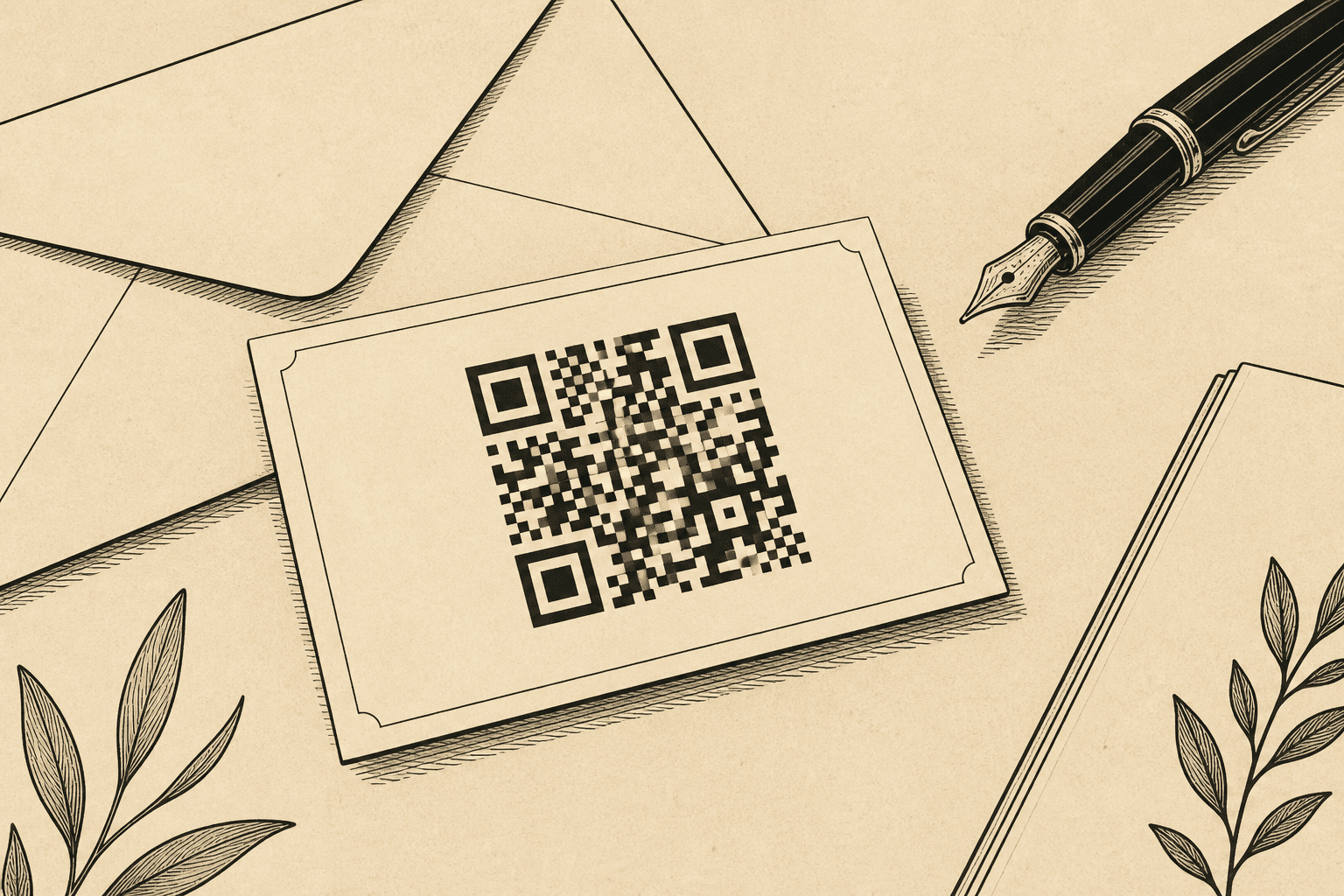
Cream business card on a desk with a large black QR code next to a phone

You are at a table, a booth, or a hallway after a talk. Someone hands you a card. You want their site or calendar — not a dead square and not last year's title. A QR code for business cards has one job: the phone in their other hand opens the right place in two seconds.

I write this for founders ordering a first box, salespeople who will change companies, and freelancers who reprint when the paper runs out, not when Calendly gets replaced. You will change jobs, domains, and booking tools. Make the card scannable. Encode a short link you own. Leave the final page in software.

Why a box of cards dies after a job change

Most card QR failures are last quarter baked into ink. Someone encoded the current site, the current Calendly, or a vCard with this year's title. Then the company rebranded, the founder moved, or the freelancer switched tools. Five hundred cards still open the old string.

A static generator writes that string into the pattern. There is no server in the middle, so there is nothing to edit. The only fix is a new image and a new print run. You reprint cards when the paper runs out, not when you take a new role. The mechanics live in static vs dynamic QR codes and how to create a QR code you can edit after printing. This guide is the card: size, one code, and what to put behind it.

Business card QR size: 2.5–3 cm, not a 12 mm corner

A standard card is about 90 × 50 mm. Designers love a 12 mm mark in the corner because it leaves room for the logo. That mark does not scan when someone is standing in a hallway with a drink. The camera hunts. They pocket the card and never open your page.

Print the square at 2.5–3 cm. That is the business card QR size I want on the printer spec. It takes real estate. It is supposed to. Two centimeters can work on a new phone in office light and is the floor, not the target. I would not go under 2.5 cm on a card I hand to a stranger.

People scan a card from about 15–25 cm. The QR code size guide for print uses a 10:1 rule, which already wants about 2 cm, then you add margin for mixed phones. Set a physical width in the layout. Tell InDesign or Canva 2.5 cm or 3 cm, keep the square square, and do not stretch it.

Phone camera locked onto a QR code printed on a business card
Proof the live card in your hand, not only a PNG on a monitor.

Quiet zone, no foil, one code

Size will not save a square that is cropped, stamped in foil, or sharing the card with a second code.

  • Quiet zone. Leave a blank margin of at least four modules — roughly a 10% frame. Cropping it into a colored box, a photo, or a logo is a common miss.
  • Contrast. Dark modules on light stock. Black on white or cream. Gray on kraft fails.
  • No foil. Foil-stamped modules glare. Cameras see a mirror, not a pattern. Skip metallic ink on the square.
  • One code. Two squares look like a bug. If you need LinkedIn and a calendar, put both on the page the one code opens.
  • Keep it square. Do not italicize the code or park a huge logo on the finder patterns.

A tiny logo in the center is optional. The quiet zone is not. If marketing wants a mark in the middle, enlarge the whole code first, then drop a small mark.

DetailRecommendation
Code size2.5–3 cm square
Quiet zoneAt least four modules, uncropped
ContrastBlack on white or cream. No foil.
Codes on the cardOne
PayloadDynamic short link to a page you own
ProofReal stock, two phones
Put this in the printer email. Width is the square itself. Add the quiet zone outside that number.

vCard vs URL: put the contact on a page you own

The vCard vs URL choice shows up on every card job. A vCard feels finished: they scan, the phone offers Add contact. That is useful — and it is static. The payload is the contact file, written into the image. When the title or phone changes, the PNG is wrong. Create QR Codes can do vCard. I will be honest: that type encodes the contact in the image. It is static on purpose. It will not follow you to the next job.

A URL to a page you own is the default I want on a card that should outlive this quarter. The page can list email, a booking link, LinkedIn, and a downloadable vCard you update when the title changes. The printed square never stores those fields. It stores a short link.

  • Use a URL when you might change jobs, sites, or tools. Founders, sales, freelancers: this is you.
  • Use a vCard only if the contact data will not move and you want an offline add-to-contacts.
  • Do not encode a Dropbox file, an iCloud share, a bit.ly you do not manage, or a profile you might lock down.

A dynamic QR on cards survives the next role

A dynamic QR on cards encodes a short tracker, not the campaign URL and not the vCard block. On Create QR Codes that tracker is a stable `/r/[slug]`. They scan, they hit that path, your dashboard decides where they go next. Swap the destination. The pattern on the card does not change.

That is how a QR code for business cards stays useful after a site move. I point the short link at a /card or /about page I will keep. This month it can redirect to a launch calendar. Next month it can go back to the site. The wallet copy does not care.

Dashboard field for editing the destination URL behind a printed business card QR
Edit the destination. The printed card stays the same.

If you want the full print-once setup, read how to create a QR code you can edit after printing. The short version for a card: create a QR code as a Link, not a vCard, unless you truly want static contact data in the ink.

How I add the code before anyone prints

Do the software first. The PNG is the last thing you place on the layout.

  1. Publish or pick the page you want scanners to open today. A /card page, your site, a calendar. You must be able to open it in a private browser tab with no login wall.
  2. Go to Create QR Codes, pick Link, and paste that URL. Confirm the image encodes the short path, not your long CMS URL.
  3. Hit Download. Confirm the email we send. Pay $1 to unlock the PNG. That attaches the code to your account so you can edit the destination later.
  4. Place the PNG at 2.5–3 cm. Keep the quiet zone. Print one card on the real stock. Scan it on two phones. Then send the file.

When the job or site changes, open the dashboard and edit the URL. Do not generate a new image. That is the reason to create a QR code as dynamic before you print.

Proof both phones on the real stock

A scan of the PNG on your monitor is not a test. Print one card. Hold it the way a stranger holds it — one hand, slightly off-axis, under hallway light. Try a recent iPhone and an older Android. If you print both sides, scan both. Soft-touch laminate and uncoated cream scan differently than an office laser.

If the camera hunts, go up toward 3 cm before you add a frame or a logo. If it opens a login wall, change the destination before you order five hundred. Scan again after you edit the hop, on the printed piece, so you know the paper did not have to change.

Mistakes that waste a box of cards

  • A 12 mm corner code because it looked cleaner on the layout.
  • Foil-stamping the modules, or gray ink on dark stock.
  • Cropping the quiet zone into a brand-color box.
  • Encoding a static vCard or a final site URL you will retire.
  • Two codes on one card, so nobody knows which to scan.
  • A Drive or iCloud file that asks people to request access.
  • Sending the file before a two-phone proof on the real stock.

If a printed card already failed, you can only repair it without reprinting when it is dynamic and you still own the short link. A static vCard or a baked-in URL is done. For the next box, create a QR code first, then print.

Your QR code for business cards should be large, boring, and editable. Give people a 2.5–3 cm square, a page you own, and a hop you can move when the job or the site changes. Then hand out the box.

FAQ

How big should a QR code be on a business card?

Print 2.5–3 cm square. That is the reliable business card QR size. 2 cm can lock on a new phone in bright light and is the floor, not the goal. A 12 mm corner mark almost never scans when someone is holding a drink.

Should a business card QR be vCard or a URL?

A URL to a page you control wins for most cards. That is the vCard vs URL choice: a vCard dumps contact fields into the image and cannot be edited later. Create QR Codes can generate a vCard, but it is static in the PNG. If you might change jobs or sites, encode a dynamic link instead and put the contact details on a page you own.

Should I use a dynamic QR on cards?

Yes, if the card should survive a job change, a new domain, or a new booking tool. A dynamic QR on cards encodes a short link. You edit the destination. The paper stays. A static URL or vCard in the image forces a reprint.

Can I change where my card QR goes after I print?

Only if you printed a dynamic code. Open the dashboard, paste the new page, save. Do not generate a new square. On Create QR Codes you pick Link, hit Download, confirm email, then pay $1 for the PNG. After that you edit the /r/[slug] destination from the account that owns it.

Why does my business card QR not scan?

Usually the square is too small, the quiet zone was cropped, foil or low-contrast ink killed the modules, or you stretched the PNG. Print 2.5–3 cm, black on light stock, no foil, and proof both phones on the real card before you order a run.

Related guides